
Bioblitz and other events

CBDC works with local conservation organisations to run Bioblitz and similar events. The purpose of a bioblitz is to record as many different species in a short period of time. These events are free and open to the public and those interested in wildlife whether you are an experienced recorder or just beginning.

Complete beginners can join in guided walks, moth trapping and family friendly activities. If you are more experienced you can come and record on your own or with fellow recorders, and, if you wish to, share you knowledge with others by helping people identify their finds or by leading activities.


Cumbria Nature Festival 2026

Coming this May, join us for a weekend of talks, demonstrations, activities and recording. An excellent way of finding out more about wildlife and how to get involved with groups and projects across Cumbria.

MORE SOON!


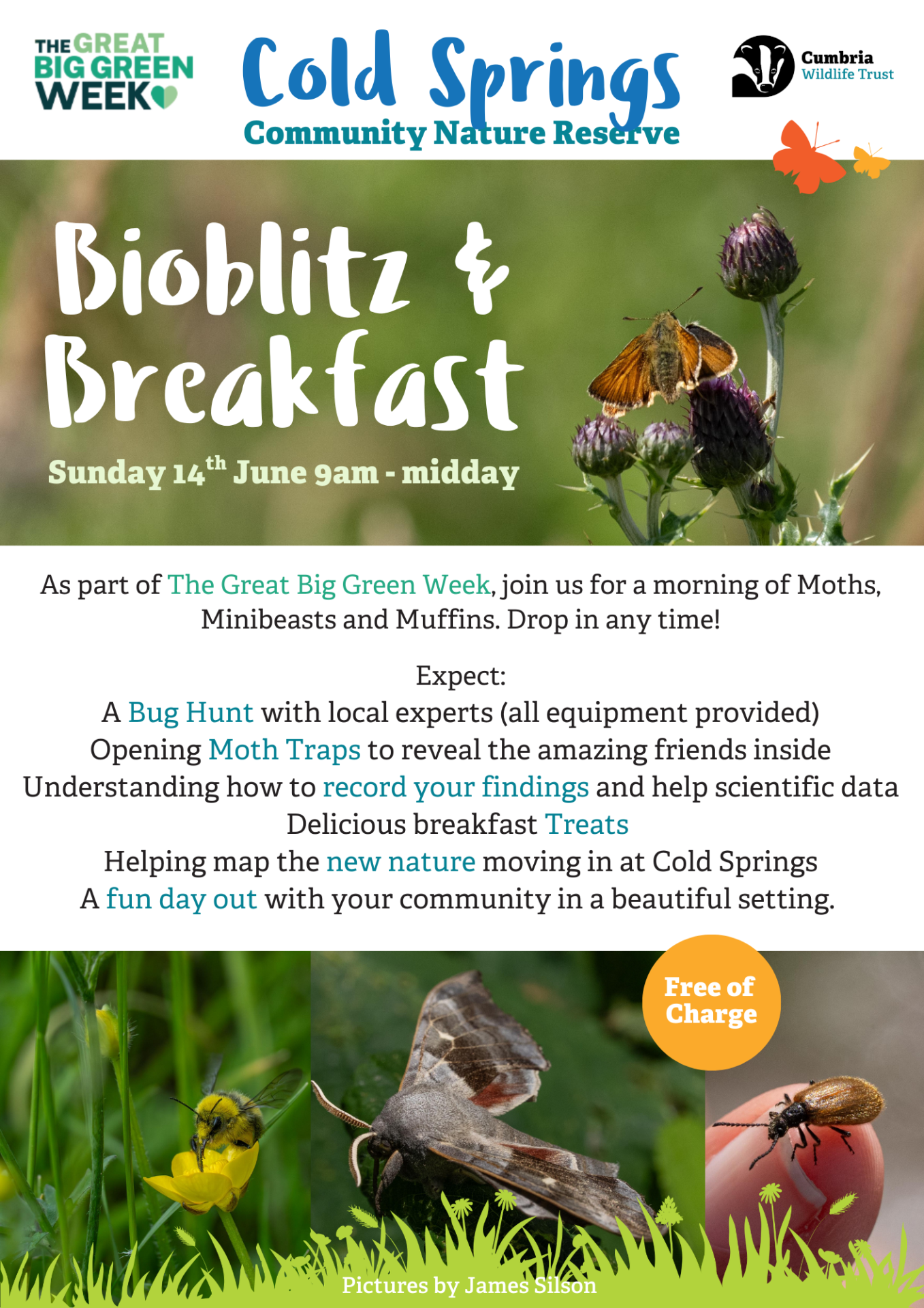
Bioblitz & Breakfast

Sunday 14th June 2026, 9am-midday

Join the team at Cold Springs Reserve in Penrith for a morning packed with moths, minibeasts and muffins! An opportunity to take part in a bug hunt so come along.....


Image


Bothel Community Wildlife Group's Bioblitz

Join Bothel Community Wildlife Group, CBDC and many others for a 24 hour bioblitz starting at noon on Saturday 10th May 2025.

Watch out for more information of how to sign up soon!

The bioblitz will take place at Park House Farm near Torpenhow.


Click here to find out details about the event

Oak Tree Animals' Charity are recording their wildlife on iNaturalist.

So, if you cannot make the Bioblitz on the 2nd May 2021 but see something when you visit another time, you can still let them know.

Download  (PDF): How to record that wildlife you see


Photograph © Woodmatters

Orin’s Bioblitz
– National Trust’s Footprint


Date: 2019

Inspired by the Rusland Horizon Bioblitz, 11 year old Orin organised his own event in July 2019 at the National Trust’s Footprint building near Troutbeck. 162 people joined Orin and his family and together they recorded 573 species.

Video coming soon!


Read more about Orin’s Bioblitz:


Woodmatters Website


Rusland Horizons
– Bowkerstead Farm & Campsite

Date: 2018

This was not a typical Bioblitz site with only 22 species records before the event. By the end we had 460 species on the list.

Rusland Horizons highlights included:
• A large orange Ichneumon fly Opheltes glaucopterus – the first time it had been found in Cumbria.
• 3 rare butterflies: Brimstone, Small Heath and the Pearl-bordered Fritillary.
• 2 records of the nationally rare Tabanus sudeticus – the dark giant horsefly. With a body length of 2.5 cm it is the heaviest fly in Europe and has a nasty bite.
• 9 protected and rare species of moths. The Ghost Moth and Pinion-streaked Snout have only been seen a couple of times before in the area.
• The once very common Garden Tiger moth is now a priority species on the UK Biodiversity Action Plan.
• Gyrinus natator is a whirlygig beetle that has become extinct in parts of the UK and is on the UK Red List for endangered species.
• Signs and tracks of Otters, Squirrels, Roe deer, moles, 2 species of shrew.
• Great footage of a badger on the camera trap.
• and a dead grass snake, a slow worm and common lizard – all of which are protected in the UK as their numbers are declining.

Watch Rusland Horizons BioBlitz Weekend 2018:
YouTube video


Eycott Hill Nature Reserve

Date: 2016

Eycott is a new Cumbria Wildlife Trust (CWT) Nature Reserve. The weather on the day was wet and windy – not the best for spotting wildlife. However, members of the public, CWT staff and volunteers and local recorders collected 275 records and identified 125 different species bringing the total list for the site to 760.

Read more about Eycott Hill Nature Reserve:
Cumbria Wildlife Trust website


Campfield Marsh Reserve

Date: 2015

The 2015 Bioblitz was held at the RSPB reserve Campfield Marsh. CBDC partnered with the Solway Firth Partnership and RSPB to organise another successful day.

The day was supported by 11 recorders who collected 798 records between them recording 412 species. The wetland site tested our botany recorders’ knowledge of sedges and rushes and the Coleopterists collected several beetles requiring microscopic identification.

Read more about Campfield Marsh Reserve:
RSPB website

Cumbria Biodiversity Data Centre

The Cumbria Biodiversity Data Centre at Tullie House Museum, Carlisle keeps wildlife information for the county of Cumbria. Tullie House Museum, in its role as a local natural history museum, has collected and disseminated records of wildlife in Cumbria since its inception in 1893. From the early 1990s the Museum has developed a computerised database of species and habitat records in Cumbria and has taken the central role in providing a local biodiversity data service for the county. This role was restyled as Cumbria Biodiversity Data Centre (CBDC) in 2010, a not-for-profit organisation hosted by Tullie House Museum and advised by local stakeholders.
Cumbria Biodiversity Data Centre
Cumbria Biodiversity Data CentreThursday, October 1st, 2026 at 1:23am
Over the next month, you might see more ladybirds coming indoors - especially if you live in more urban areas of Cumbria like Carlisle and Kendal. While native ladybirds will over-winter in garden sheds, leaf litter and crevices in woody plants or fences, the non-native Harlequin (Harmonia axyridis) is looking for somewhere a little warmer to spend the winter diapause and will enter houses to congregate in corners. These ladybirds are originally from Asia so need drier and warmer conditions than the native species.

The Harlequin is very variable - hence the name. The two examples shown here were collected at the same time in the same place! Some colour patterns can look very similar to the native species but generally Harlequins have brown legs and undersides while native species tend to have black legs/underside. Harlequins tend to be quite large too compared to the more variable sizes seen in the 45+ native species.

Over-wintering ladybirds won't do any damage and shouldn't pose a problem wherever you find them. But if you do find some in your home and they have brown legs, you can be confident that they are the Harlequin. Do record any ladybirds that you see so we can better understand the key locations of Harlequins across Cumbria and how they might be interacting with the natives.

And if you want to see a plentiful number of Harlequins this month, Mayor's Drive near Bitts Park in Carlisle is usually a good spot.
Cumbria Biodiversity Data Centre
Cumbria Biodiversity Data CentreWednesday, September 23rd, 2026 at 4:57am
Cumbria has over 1500 County Wildlife Sites, many on private land. We are working with @CumbriaWildlifeTrust to provide free surveys of these sites so we can understand their condition and help guide landowners to find management advice and support.

Find out more about County Wildlife Sites in general and across Cumbria using these resources - and contact the Cumbria County Wildlife Sites Project if you think you have a site and would welcome a survey.

https://www.cumbriawildlifetrust.org.uk/wildlife/county-wildlife-sites
https://www.gov.uk/government/publications/local-sites-and-nature-conservation/local-sites-and-nature-conservation
Or the LWS Hub: https://www.localwildlifesites.org/
Cumbria Biodiversity Data Centre
Cumbria Biodiversity Data CentreWednesday, September 16th, 2026 at 1:12am
As well as the excellent Plantlife resources and Waxcap Watch, CBDC has two upcoming waxcap training sessions - Thursday 8th October and Sunday 1st November. We're finalising details but do let us know if you would like more information/have priority booking by completing our expressions of interest form:
https://docs.google.com/forms/d/e/1FAIpQLSe5JQ99XCSMMIyUX641NL8EqGz6gXH4C2hItqp9EFL-iFXhKw/viewform?usp=publish-editor
Cumbria Biodiversity Data Centre
Cumbria Biodiversity Data CentreMonday, September 14th, 2026 at 5:51am
It is apple season! The apple harvest looks good again this year - albeit with possibly smaller apples than usual. Traditionally managed orchards are good sites for biodiversity but their location and condition in Cumbria are not well understood. If you manage a traditional orchard, tell us about it. Do get in contact if you would be willing to share information about your orchard.
Cumbria Biodiversity Data Centre
Cumbria Biodiversity Data CentreFriday, September 11th, 2026 at 12:56am
Ever wondered who works at @CBDC and what they do? Over the next few months, we'll feature a different team member each month and find out a little more about their role. So watch out in October for the first profile.....

We asked a well-known AI chatbot to create a cartoon of the CBDC team and it developed this image. Find out what it got right and what it got wrong in the coming months.
Cumbria Biodiversity Data Centre
Cumbria Biodiversity Data CentreWednesday, September 9th, 2026 at 1:06am
Biological recording in the autumn months sees a shift from recording flowering plants and summer migrant birds to fungi and winter migrant birds. Look out for the different fungal fruiting bodies that are appearing widely across different habitats at the moment - this year is already looking very promising for fungal forays.