
Credit: Peter Skillen 2025
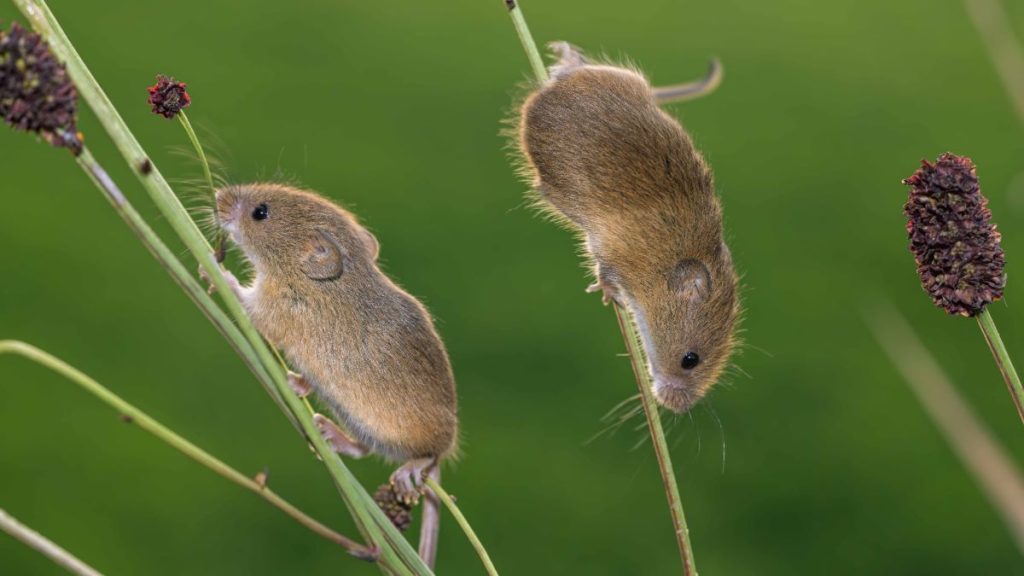
Harvest Mice (Micromys minutus) are of the order Rodentia and belong to the family Muridae. They are Great Britain’s smallest native species and are classified as ‘Near Threatened’ on the UK Red List. The distinguishing features of the Harvest Mice are their blunt noses, prehensile tails and their golden orange brown colouration during the summer. Their body length ranges between 50mm to 70mm and their tail is the same length as their body. The weight of an adult ranges between 4 to 9 grams. In the wild they live for approximately 18 months in perfect habitat but being an important prey species, few survive their first winter.
The Ecology of Harvest Mice
Harvest Mice moult once a year from a dusky dark brown and grey body throughout the winter to a golden orange brown colouration in the summer. They have a white underbelly that extends to underneath the chin. Their tails are prehensile which enables them to use them as a braking system while climbing down stalks, for balance and it is also used as a communication tool.
Credit: Peter Skillen 2025
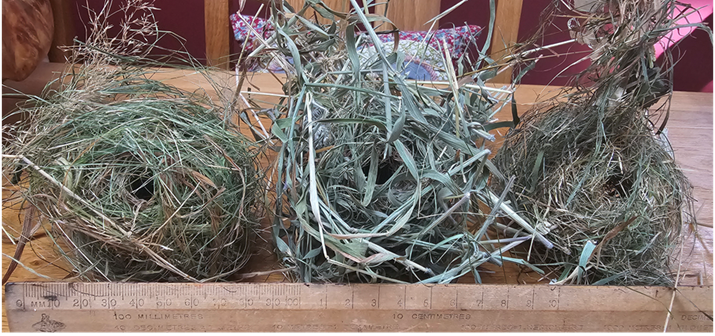
Harvest Mice are active all year-round foraging on a variety of seeds, roots, fungi, mosses, insects and berries. The female builds nests by weaving vegetation either under clumps of tussocky grass or higher off the ground in tall grasses, reeds and hedgerows. Being a crepuscular mammal, they are highly active during dusk and dawn but do venture out regularly during any time of the day and night.
A female Harvest Mouse builds several nests for a variety of uses. These can be for giving birth in, a stopover nest site for food sources or close to a food stash or water resource for themselves to use as cover. Both older juveniles and males will often take advantage of these temporary nests to sleep in.
Credit: Jude Hartley 2025
Recording Harvest Mice
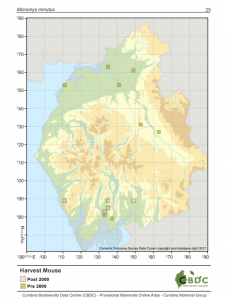 In 2020 a five-year project was started by Cumbria Mammal Group to survey and record Harvest Mice presence by encouraging volunteers to find Harvest Mice nests.
Results show fractured distribution with many areas lacking surveyor effort.
Due to their size, speed, colouration and habitat they are a challenging species to accurately record.
Records are infrequent and Harvest Mice are thought to be rare and declining in the county. The results, however, do show they are persisting.
Cumbria Harvest Mice Project 2025
We are Phase 2 of the previous five-year project. As of summer 2025, a new team of Mouseketeers have taken up the baton, transitioning the initiative into a more direct-action group to be known as Cumbria Harvest Mice Project (CHMP).
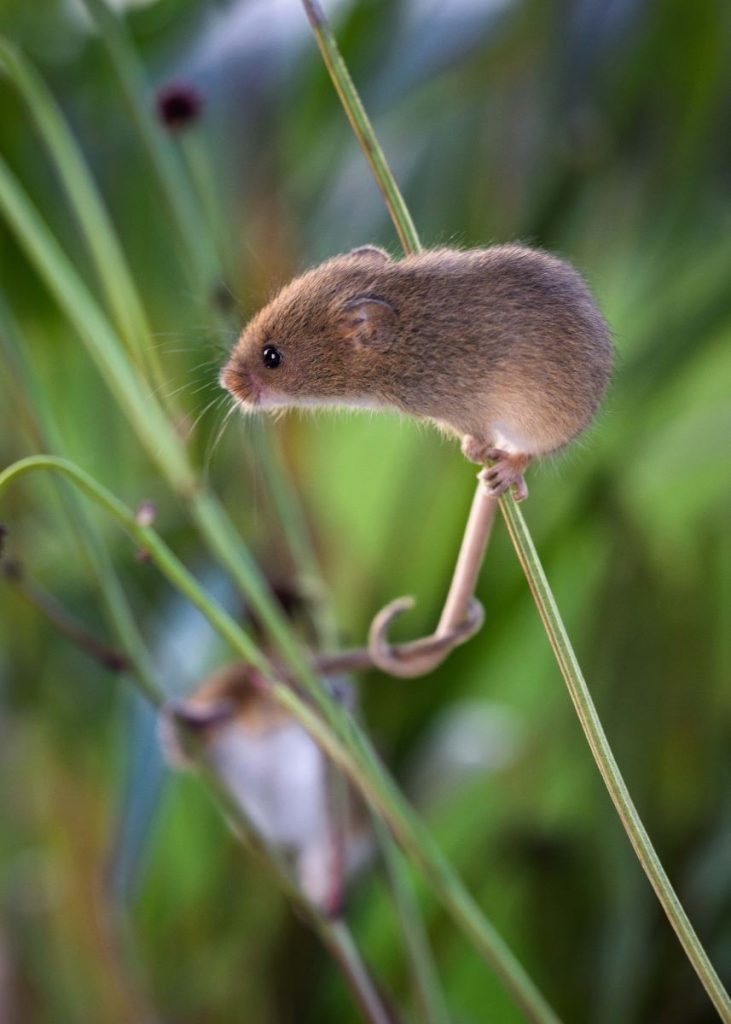
Credit: Peter Skillen 2025
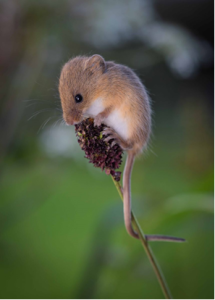
Credit: Peter Skillen 2025
We are a small group of people dedicated to the conservation of our native wildlife and in particular those in Cumbria with the aim of readdressing the balance. We will do our best to increase the number of Harvest Mice in their home range.
The project involves breeding Harvest Mice exceeding the British and Irish Association of Zoos and Aquariums (BIAZA) husbandry care guidelines. This is followed by soft release into chosen sites.
Harvest Mice are recognised as curious and incredibly intelligent mammals with complex individual traits.
The mice are bred in an environment that mimics their natural environment which encourages natural instinctive behaviour such as foraging, scent marking and nest building.
They are given seasonal food ‘still on the stalk’ to encourage natural behaviour and to prepare them for their future release.
Alongside the breeding programme of Harvest Mice, we aim to educate on their ecology and actively engage with interested communities.
For more information about CHMP, please contact: harvestmousecumbria@gmail.com
Please continue to submit your observations of Harvest Mice to CBDC using a recording app (iRecord, iNaturalist), the CBDC spreadsheet or the CBDC online records submission form.
Credit: Adrian Pini 2025